


1. Home
  2. Sport
  3. Horse Welfare

Horse welfare

Horse & Rider. Fit to continue.

Endurance is judged on the horse as much as the clock. At Butheeb every horse is examined by an independent Veterinary Commission before the start, after every loop and at the finish. A horse that is not fit to continue does not continue, whatever the standings.

The principle

The horse decides, not the clock

A 160-kilometre ride is a serious physical effort for any horse, which is why the sport is built around one rule: the horse must be fit to continue at every stage, and someone other than the rider gets to decide. That someone is the Veterinary Commission, a panel of FEI veterinarians with no connection to any team.

Their checks are not a formality. On a championship day it is normal for a share of the field to be withdrawn at a vet gate, most often for a minor lameness or because the horse is not recovering as it should. Those horses are treated, rested and go home well. That is the system working.

At Butheeb this principle has a name: the Butheeb Protocol, a welfare-focused approach developed under the vision of the late H.H. Sheikh Sultan bin Zayed Al Nahyan, which rewards responsible horsemanship through recovery time, heart rate, gait and metabolic condition. This page explains what happens at a vet gate, who is looking after the horses, and what we publish about it. It is written for spectators, families and first-time fans; the full FEI Endurance Rules are on the Rules & schedules page.

64bpmMaximum heart rate to pass a vet gate
15minPresentation window after a loop · 20 min at the finish
60secMaximum time for the vet inspection
7Inspections per horse: pre-ride, five gates, final

Heart rate is measured with the electronic monitoring system at the gate. Holds are 50 minutes after Loop 1, 40 minutes after Loop 2 and 50 minutes after Loops 3, 4 and 5.

Step by step

What happens at a vet gate

A vet gate is where every loop ends. It looks like organised chaos: crews, buckets, ice, vets with stethoscopes. This is the order of it.

  1. Arrival

    The rider crosses the in-line and dismounts. The clock keeps running: the loop time only stops when the horse passes the vet.

  2. Cooling

    Crews pour water over the horse, scrape it off and go again, working the heart rate down. Four crew members plus the athlete may work on a horse in the cooling area.

  3. Heart rate

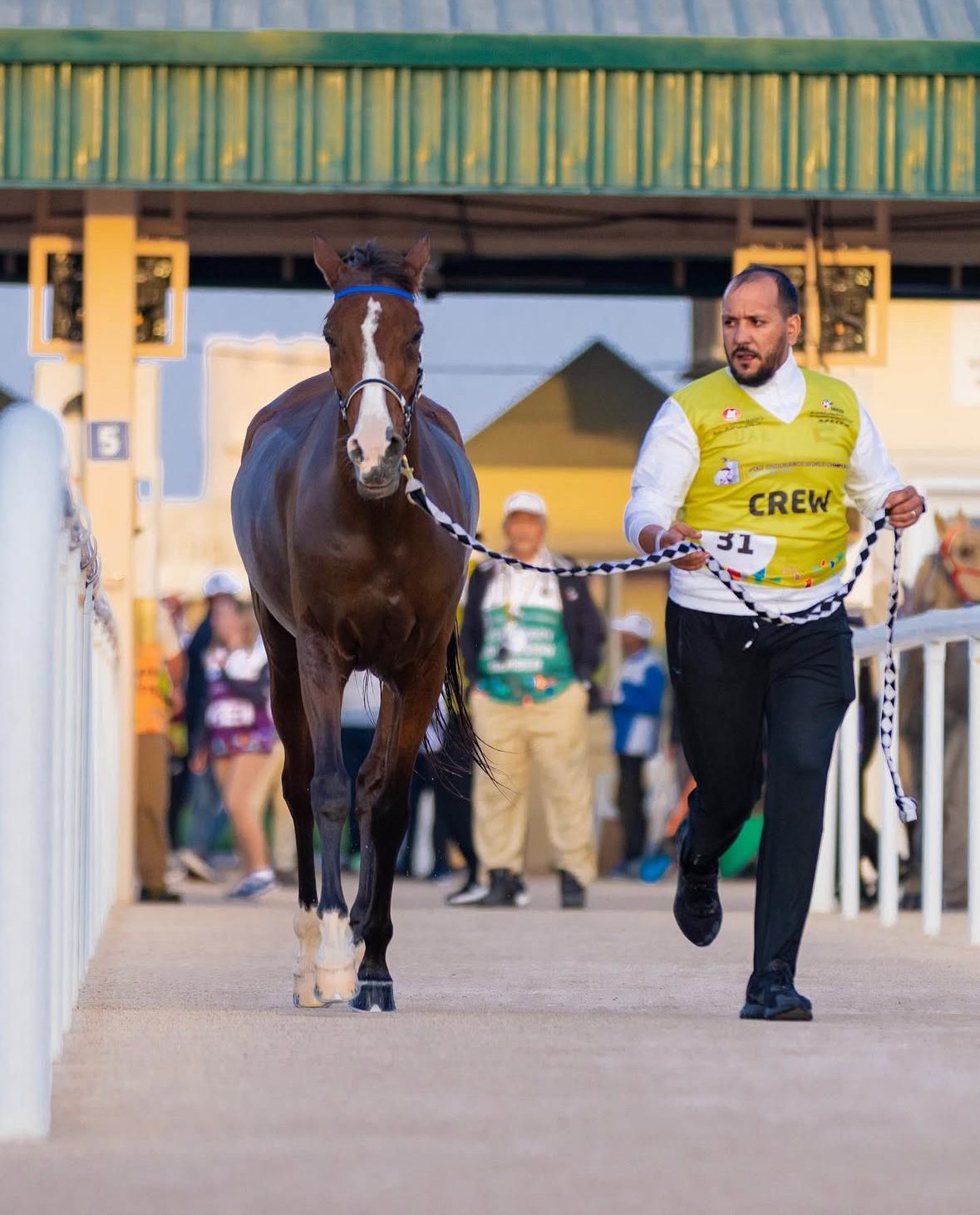
    When the crew believes the horse is ready, and within 15 minutes of arrival, the horse is presented; only two crew members plus the chef d’équipe or team vet come into the inspection area. The heart rate is taken electronically: it must be 64 beats per minute or below.

  4. Trot-up and checks

    The horse trots out and back on a loose rein, led from its left side, so the vets can watch it move. They check gut sounds, hydration, mucous membranes, muscle tone, back and girth, and any cuts or rubs. The whole inspection takes no more than 60 seconds.

  5. The decision

    Fit to continue: the loop time stops and the hold begins. Not fit: the horse is withdrawn, the reason is recorded, and it goes straight to the treatment vets if it needs them.

  6. Hold and out

    During the 40- or 50-minute hold the horse eats, drinks and rests, and passes a recovery inspection in the last 15 minutes before it leaves. Then the rider is released onto the next loop.

Veterinary Commission

A President and a panel of FEI-listed veterinarians appointed for the championship. They judge every inspection and their decisions are final.

Treatment veterinarians

A separate team, with a fully equipped clinic in the Village and vehicles on the course. They treat; they never judge.

FEI Veterinary Delegate

The FEI's own appointee, overseeing the welfare protocol, medication control and the horse passports and vaccinations checked on arrival.

Stewards

The Chief Steward and the stewards supervise the stables, the cooling and crewing areas and the course.

The people

Who is looking after the horses

The people who judge whether a horse continues are never the people who treat it. That separation is deliberate: the Veterinary Commission has no reason to be lenient, and the treatment vets have no reason to be anything but thorough.

Every horse arrives with an FEI passport, up-to-date vaccinations and a clean medication record, all checked at the stable gate before it is allowed into the Village. Medication control testing takes place during and after the championship.

The names of the Veterinary Commission and officials for Butheeb 2026 are published with the FEI schedule on the Organising Committee & officials page.

Cooling, water, shade

Built for a December desert

Butheeb is ridden in the coolest month of the year, starting at 05:45 so that the horses do most of their work in the cool of the morning, with an expected 16 to 24 °C from morning to midday. The two shortest loops are ridden last.

The Village is laid out around a central vet gate with 14 inspection lanes, so that horses flow from arrival through cooling and holding to inspection and departure. Heart rate is monitored electronically, every horse is verified by microchip, and a modern equine clinic with digital radiography and ultrasonography sits close to the gate, with separate isolation and quarantine stables and horse ambulances positioned on the course.

On the course, crewing is allowed only at the marked water points on each loop; anywhere else it means disqualification.

05:45Start before dawn, in the cool
14Inspection lanes at the central vet gate
16–24°CExpected climate, morning to midday
GPSLive tracking of every horse on the course

Best condition

The award the riders want most

After the medals, the Veterinary Commission examines the leading horses again and names the one in the best condition: the horse that has come through 160 kilometres looking as though it could go round again. It weighs recovery, soundness, hydration and overall impression against the time the horse recorded.

Ask any endurance rider which trophy they would choose and most will say this one. It is the sport's way of saying that how you finish matters as much as when.

When a horse does not continue

No shame in a withdrawal

Horses are withdrawn for three broad reasons: the horse is lame, the horse is not recovering metabolically, or the rider chooses to stop. On the live results we show the reason in plain words, not a code, because there is nothing to hide.

A withdrawn horse goes to the treatment clinic if it needs to, is rested, and travels home when the vets are happy. Its rider has done exactly what the sport asks.

Questions people ask

Straight answers

Is 160 km too far for a horse?

Endurance horses are bred and trained for distance over years, and they qualify for a championship through a ladder of shorter FEI rides. On the day, they are checked seven times by independent vets. A horse that is struggling is stopped long before it is at risk.

Why does the clock keep running at the vet gate?

Because it rewards the rider who arrives with a horse that recovers fast, rather than one who has pushed it to the limit. Riding for a quick recovery is riding for the horse.

What happens if a horse is injured on the course?

Treatment vets in vehicles are stationed around every loop, with a fully equipped clinic in the Village and transport on standby. The rider stops, the vets come to the horse.

Is there medication testing?

Yes. FEI medication control applies before, during and after the championship, with samples taken under the FEI Veterinary Delegate's supervision.

Will you publish welfare figures after the event?

Yes. Completion rate, withdrawals by reason and treatments given are published with the final results, in English and Arabic.